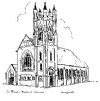
St Paul's Baptist Church, Skegness
Christ centred and community focused

A History of Monksthorpe Chapel
The Monksthorpe Chapel was built in 1701 and was evidently erected as soon as possible after the Toleration Act of 1689, no doubt as soon as funds could be raised. Under the Five Mile Act of 1665 a Nonconformist preacher or teacher could not preach or teach within five miles of a corporate town. Although its penalties were removed by the Toleration Act, this Act had not been repealed. It was a delicate situation. A chapel could legally be built within the five mile limit though it must be registered with the bishop or magistrate and its doors must be kept unlocked during services.
It was, however, illegal for a Nonconformist preacher to preach there. Nevertheless, if he did, he would not be arrested! Concessions indeed had been made to Dissenters, but they were minimal and they did not apply to Catholic Dissenters or to Unitarians. Who knew whether or not they might be withdrawn at any time and persecution re-commenced? It had happened before and it could happen again at a turn of the political wheel. Better play safe and put your building where it would not be noticed! Also plan it so that, if it were actually noticed, no-one would recognise it as a chapel, but would think it was a barn or a row of cottages or something!
Furthermore prejudice was strong against Dissenters and prejudices die hard. Hitherto informers had been bribed with a third part of any fine levied and informers had been plentiful. Now they had lost this source of gain. Furthermore it was, and indeed remained so for a century or more, a popular sport to carry out acts of violence against Dissenters, to throw stones or filth at them, break their windows, damage or steal their goods, hold their heads under the water in a pond or river until they were nearly drowned. So Monksthorpe chapel was built in this out-of-the way place where its members had long been accustomed to worship in the open air, the look-out was posted and the escape hatch and ladders provided for the preacher. The escape hatch is still there!
A list of members dated April 28, 1782 in the church book which gives their places of residence, shows that the ninety-nine members at that time came from at least twenty-four different villages and hamlets. (later there were twenty-seven). If this list is examined with the help of a large scale map it will be seen from what a wide area the members of the church were drawn. It can also be justly assumed that there would be a significant number in the congregation who were not on the membership roll.
It does not require much imagination to picture these men and women and their children tramping miles across the fens, some few perhaps on horses, following the paths they knew so well, to reach this distant place of worship. No doubt on the dark Winter nights they carried lanthorns to avoid the water courses and swamps. One reason for its situation was so that it could be be in a position to serve this wide area, and its congregation was willing to walk however far it was. There is a brick-lined open air baptistry in the grounds of the chapel about sixty yards from the entrance. It has three sides and the water becomes gradually shallower as the floor shelves upwards on the fourth side. It looks slightly like a village duck pond whether this was intended, as it might well have been, or not!
The chapel at Monksthorpe, still the original one, is a building which the Lincolnshire Baptist fathers would have known. It is an attractive old building, and except for its roof, which is no longer thatched, it is much as it was when used by them, though in need of considerable repair. Regular monthly services were held there until twenty years or so ago.
The membership of the combined Burgh/Monksthorpe remained quite high for a country church, reaching 134 in the first half of the 19th century though it declined to about half that number during the latter half of the century and sank to less than ten by the beginning of the 20th century. After this, under the enthusiastic ministry of John Dowse, who had been minister in the 1880s, membership began to rise again, though not to the level it had once been. The weight of membership of the church, which had formerly been at Monksthorpe, moved to Burgh where there was a fair population on which to draw. During the 1840s the cause was reasonably prosperous and the chapel was restored, but later, decline set in.
During the first decade of the 20th century, during the ministry of John Dowse a determined effort was made to restore the buildings and the cause at Monksthorpe. John Dowse was a local man who had prospered in business in Birmingham and his ministry was an honorary one. He himself made generous financial contributions to the restoration and provided endowments for the Burgh/Monksthorpe work. The Skegness Baptist Church also took a keen interest in the project, providing contributions and encouragement. This historic chapel is an important part of our Baptist heritage. It recalls not just 'old, far off unhappy things and battles long ago' but faith, determination and courage.
Christmas Carol Service - 13th December 2025
A beautiful sunny winters day as we gathered at Monksthorpe Chapel for the carols, readings, monologues and a Christmas message from Raish Sarin. A big thank you to all those who put these events together in such a beautiful historical setting.


"When Faith Seems Impossible" By Raish Sarin
July 2025
A glorious hot, but thankfully breezy, day as a few of us had a trip out to the historic Monksthorpe Chapel (built in 1701). Hidden away and circled by trees, a truly stunning setting for an afternoon of worship and reflection. On this occasion, Raish had the privilege of leading and preaching. The readings, sermon and some photos below.
Readings: Ecclesiastes 3:1-8, Matthew 12:46-50 & Psalm 91:14-16 (Read by Cathy Sarin)
Message: "A Fruitful Older Age!" by Raish Sarin